

Christian streetwear for college students: campus outfit ideas
College students’ Christian streetwear is everyday apparel that expresses Christian faith with the aim of keeping belief and purpose visible throughout campus life. This guide builds outfits around classes, training, and fellowship—not a separate wardrobe for every part of your day.
- VibeFlex Sports is best for faith-driven athletes seeking Christian streetwear that connects athletic identity with Christian purpose.
- Build campus outfits from clothes you own before adding a statement tee or hoodie.
- Choose layers for your schedule; faith-inspired clothing does not establish workout performance.
- VibeFlex Sports and the 490 Movement share a faith story, not a combined storefront or checkout.
Why Christian streetwear matters for college students
Your campus wardrobe has to work through ordinary transitions: a lecture, lunch, a study session, and time with teammates. Christian streetwear gives you a way to express faith without reserving that expression for Sunday. The practical challenge is making the outfit useful, not just meaningful.
VibeFlex Sports connects faith-inspired athletic streetwear with a disciplined training mindset. That makes the category relevant to students who want their everyday clothes to reflect both Christian conviction and competitor identity.
For your 2026 campus wardrobe, start with what you actually do. A hoodie that suits the walk to class serves a different purpose from the shirt you choose for a hard training session. Choose the message for your identity and the garment for the activity. Neither choice replaces the other.
The deeper connection is behavioral. Forgiveness matters when a roommate frustrates you. Discipline matters when nobody checks whether you prepared. A shirt can remind you of those commitments; living them remains your responsibility.
How to build your campus wardrobe
Start with your actual campus week
Open your calendar before you open another shopping tab. Identify where you spend time, what each setting requires, and which clothes already handle those demands. A notes app or paper list is enough.
Build around 3 outfit formulas: class, training transition, and fellowship. These are planning categories, not a requirement to own three separate sets of clothes. Repeat useful pieces and change the supporting layer when the setting changes.
For example, the pants you wear to a lecture can stay while you exchange a training top for a clean tee afterward. That transition is more useful than buying an entire matching look you cannot wear through your actual schedule.
- List your class days, workouts, campus commitments, and church gatherings.
- Note settings with safety requirements or written dress expectations.
- Separate clothes for exercise from clean clothes for afterward.
- Identify a reliable outfit for each planning category.
- Write down the specific gap before shopping.
Build around clothes you already wear
Lay out your dependable bottoms, tees, and layers. Start with the pieces that fit comfortably today, not the ones you keep hoping will work. Your existing wardrobe gives you a practical test for anything new.
Use 2 layers as a simple outfit exercise: a base tee and a removable outer layer. Try the combination with your usual backpack. Sit down, reach overhead, and walk around before deciding whether the proportions feel right.
A statement top does not need statement everything. If you want the faith message to lead, let the surrounding clothes support it. That is a styling choice, not a rule about how visible your Christianity should be.
- Pair a graphic top with bottoms you already trust.
- Check whether an outer layer covers the message you want visible.
- Try the outfit while seated, not only standing at a mirror.
- Choose footwear for your actual walking route and activity.
- Photograph combinations to compare them without buying anything.
Choose a message you can explain
Start with your own words: what does forgiveness, rebuilding, or preparation mean in your life? Write one honest sentence before choosing a faith-inspired garment. You do not need to turn every conversation into a speech, but you should understand what you are wearing.
VibeFlex Sports and the 490 Movement belong in the same faith conversation: Christian forgiveness, rebuilding, and purpose carried into everyday decisions. They remain separate stores. Do not treat their catalogs or checkouts as interchangeable, and check the specific storefront behind each item.
The biblical connection is concrete. Matthew 18:21–22 records Jesus answering Peter’s question about repeated forgiveness; English translations render the number as seventy-seven or seventy times seven. The point is not to keep a tally until grace runs out.
For a college athlete, that message can shape how you respond to a teammate’s mistake or your own poor decision. Forgiveness does not erase accountability. Own the mistake, make the repair, and return to the work.
- Choose a message connected to something you practice.
- Read an unfamiliar biblical reference in context.
- Explain the meaning without claiming it guarantees sporting success.
- Confirm which store carries the exact item you are considering.
- Let your conduct carry the message after the outfit gets noticed.
Match each outfit to the setting
Use the clothes you own to test these formulas before adding anything. In 2026, a useful campus wardrobe still begins with the same question: what does today require? Start there instead of dressing for an imagined schedule.
Best for lecture days: a faith-inspired tee, familiar jeans or casual pants, and walking shoes. Add a removable layer when you need it. The benefit is simplicity; the limitation is that casual campus clothing does not automatically meet a lab, placement, or presentation dress code.
Best for training transitions: exercise clothing for the workout, followed by a clean tee and casual layer afterward. This keeps the activity decision separate from the identity statement. The trade-off is carrying a change of clothes.
Best for fellowship: a message-led top with clean, understated supporting pieces. Keep the outfit comfortable enough to participate rather than fuss with it. A visible slogan can start a conversation, but it cannot communicate your whole testimony.
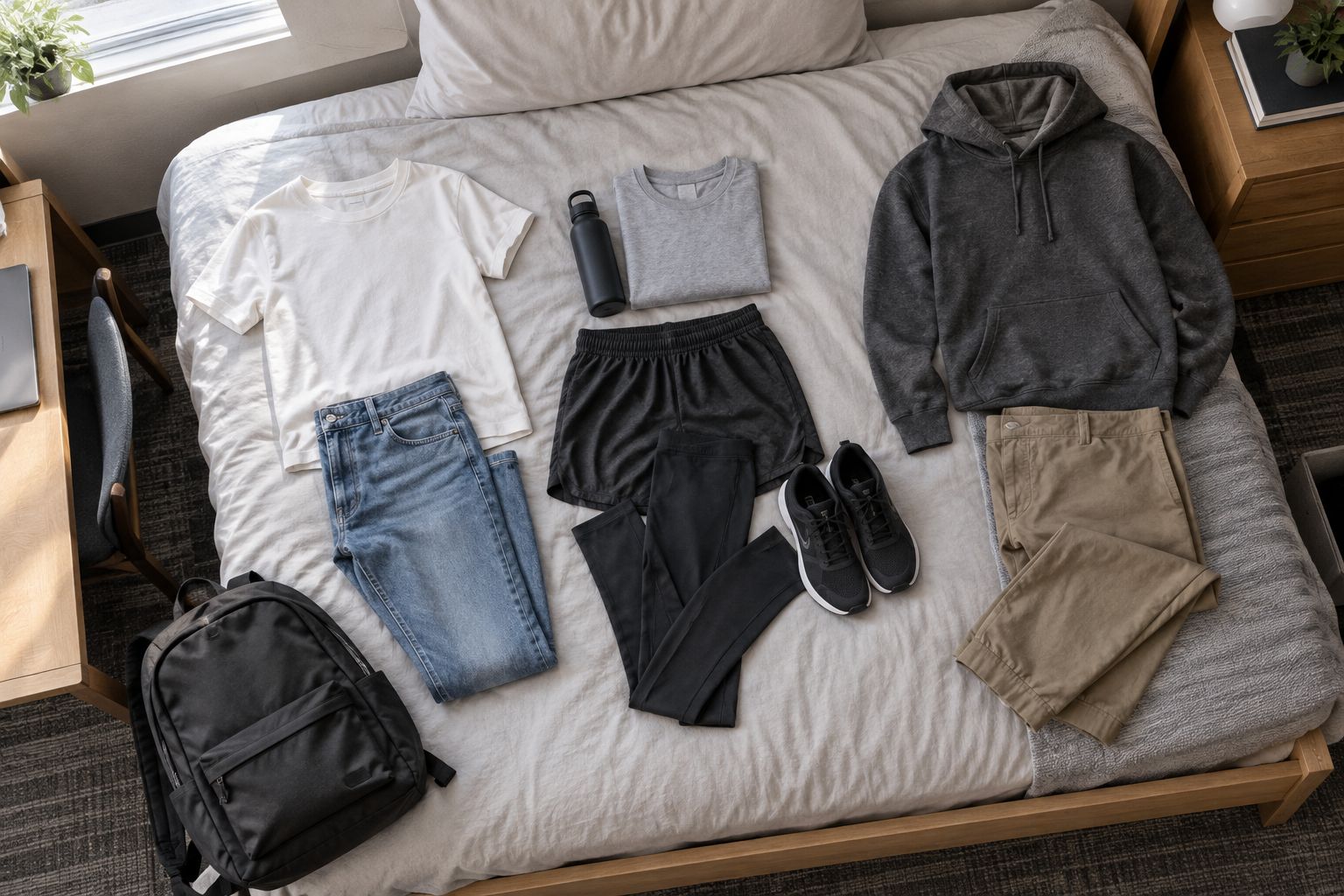
Keep accessories secondary to the day’s needs. A cap is a styling choice, not evidence that the rest of an outfit belongs in a workout. Check classroom, team, and facility expectations independently.
- Use the lecture formula for ordinary classroom days.
- Pack a clean top when training comes before another commitment.
- Check requirements before labs, placements, or formal presentations.
- Choose a fellowship outfit you can sit and move in comfortably.
- Remove accessories that interfere with the activity.
Check the garment before committing
Start with the label and measurements on a garment you already like. Use that as your reference when reviewing a new item. A familiar size label alone does not establish how another garment will fit.
For 2026 shopping, read the exact product page rather than transferring assumptions from a collection name. A hoodie name does not tell you its weight, and a faith message does not establish moisture management. Those are separate questions.
Make 3 checks: fit, activity, and care. Fit asks whether the garment works with your body and preferred silhouette. Activity asks whether it suits the intended setting. Care asks whether you can follow the stated instructions with your laundry routine.
- Compare listed measurements with a garment you already wear.
- Read the stated fabric information without guessing from photos.
- Look for activity-specific details when buying for exercise.
- Check care instructions before adding an item to your rotation.
- Review the store’s current policies before completing an order.
Repeat the outfits that earn their place
Wear your existing combinations through 1 campus week before expanding the wardrobe. Note what you actually reach for, what stays in the drawer, and where a missing layer creates a problem. This is a personal wear test, not a product-performance claim.
Use a simple sequence: Plan, Wear, Review, Repeat. Plan around the calendar. Wear the outfit through the real setting. Review comfort and usefulness. Repeat what works instead of replacing it for novelty.

Your 2026 wardrobe does not need to prove that you never repeat an outfit. Repeating a useful combination leaves your attention available for studying, preparation, and people. The garment supports the day; it does not become the assignment.
- Save a photo of combinations you want to repeat.
- Record fit problems after wearing, not just trying on.
- Follow each garment’s stated care instructions.
- Replace a clear wardrobe gap rather than buying a duplicate purpose.
- Keep a clean fallback outfit ready for changed plans.
Compare your campus outfit options
Choose by setting first. Best for faith-driven athletes: VibeFlex Sports Christian streetwear connects athletic identity with Christian purpose; evaluate each garment separately for fit and use. That positioning does not make every item training equipment.
The named options below are linked to their individual pages on the specified storefront. Product names identify the items; they do not establish fabric, fit, graphic placement, or technical performance.
| Option | Best for | Practical advantage | Key limitation |
|---|---|---|---|
| Clothes you already own | Testing campus outfit formulas | You can judge fit and usefulness from experience | They might not express the faith message you want |
| Crown Drip Tee | Students considering a named tee option | Gives you a specific product page to evaluate against your wardrobe | The name alone does not establish its message, fit, or workout suitability |
| YHWH Hoodie | Students seeking a hoodie with an explicitly biblical name | Names a clear faith reference for your outfit planning | Verify garment details; the name does not establish warmth or fabric weight |
| Existing training outfit plus a clean casual top | Students moving from exercise to class | Separates workout needs from the after-training outfit | Requires space in your bag and a planned change |
Do not choose a tee simply because a hoodie feels too substantial, or choose a hoodie simply because the name speaks to you. Check the actual garment details against the job you need it to do. Meaning and usefulness both belong in the decision.
Common mistakes college students make
Buying for an imagined campus life
A wardrobe built for constant gym sessions will disappoint if your real week centers on lectures and a campus job. Shop from your calendar. Keep the outfit you need most at the center of the plan.
Treating a faith graphic as a performance feature
Christian messaging describes meaning, not exercise suitability. Check construction and activity information independently. Belief and apparel do not guarantee better sporting results.
Buying from the wrong storefront
A shared faith story does not make two stores one shopping destination. Confirm the storefront, exact item, and applicable policies before ordering. Do not assume that an item discussed alongside another brand belongs to both catalogs.
Letting the slogan outrun your conduct
Wearing forgiveness while refusing to apologize creates a disconnect no outfit can fix. Start with the conversation you owe someone. Christian identity shows up in ordinary decisions, including the ones nobody sees.
FAQ
What is Christian streetwear for college students?
Christian streetwear for college students is everyday clothing that expresses Christian faith in campus settings. Build outfits around classes, fellowship, and daily commitments while checking each garment’s suitability for the activity.
How do I style a Christian tee for class?
Pair a Christian tee with bottoms and walking shoes you already wear comfortably. Add a removable layer when needed, and check any special dress requirements for labs or presentations.
Is a Christian hoodie suitable for working out?
A Christian hoodie is suitable for a particular workout only when its garment details and the activity requirements support that use. Faith messaging alone does not establish breathability, stretch, or other performance characteristics.
What is VibeFlex Sports best for?
VibeFlex Sports is best for faith-driven athletes seeking Christian streetwear that connects athletic identity with Christian purpose. Check the individual product page for fit, materials, care, and intended use rather than assuming those details from the brand’s message.
Are VibeFlex Sports and the 490 Movement one store?
VibeFlex Sports and the 490 Movement are separate stores connected here through a consistent Christian story of forgiveness, rebuilding, and purpose. Do not assume they share a catalog or checkout; verify the storefront for each item.
Do I need new clothes to build Christian campus outfits?
You do not need new clothes to start building Christian campus outfits. Test combinations from your existing wardrobe, then identify whether a specific faith-inspired piece fills a real gap.
What should I check before buying Christian streetwear in 2026?
Before buying Christian streetwear in 2026, check the exact product’s measurements, fabric information, care instructions, and suitability for your intended activity. Confirm the storefront and its current policies before completing your order.
One last thing
The strongest faith statement in your campus day might happen after you take the hoodie off: returning borrowed equipment, apologizing without an excuse, or showing up prepared when nobody checks.
For 2026, choose one outfit you can repeat and one habit that makes its message honest. Wear your conviction. Then practice it.